

Hardware Deep Dive · 2026
A Technical Deep Dive into the Smart Glasses Hardware, AI Stacks, and Tradeoffs Nobody Else Is Talking About
Waveguide optics, always-on SoC power budgets, multi-model AI inference at the edge — the real engineering story behind the wearable computing renaissance.
There’s a certain class of tech announcement that gets covered exclusively by people who haven’t read the datasheet. Smart glasses in 2026 have attracted enormous consumer press, but almost all of it misses the actual story — which is happening at the intersection of packaging constraints, photonics engineering, SoC thermal budgets, and on-device AI inference architectures that didn’t exist three years ago.
This isn’t another “which glasses let me ask Gemini for a recipe” roundup. We’re going into the silicon, the optics stack, the power envelope decisions, and the architectural bets each major player is making. Because the choices being locked in right now — waveguide geometry, AI model quantisation strategies, sensor fusion pipelines — will determine which platform actually matters in 2028.
If you’re an engineer, developer, or technically literate enthusiast trying to understand what’s actually competitive in this space, you’re in the right place.
Architecture
Why Three Tiers Exist — and What Each One Sacrifices
Google’s Android XR strategy made explicit what the industry had been quietly building toward: a three-tier device taxonomy defined entirely by display complexity. Understanding why the tiers exist is more useful than memorising product names that will change every 18 months.Tier 1 — Audio-only (no display): The Ray-Ban Meta generation. The constraint here is purely electromechanical: open-ear speakers, a 12MP camera, a microphone array, and an always-on SoC — all in a frame that weighs under 50g and must survive sweat and rain. No waveguides. No photonics. The AI pipeline lives mostly in the cloud, with the on-device SoC (Qualcomm Snapdragon AR1 Gen1 and its successors) handling VAD (voice activity detection), wake-word detection, and basic image buffering. Battery life is achievable because you’re not driving a display. This is the tier that will hit mass market first — Meta is targeting 10 million units of production capacity by end of 2026.
Tier 2 — Monocular display: One micro-display, one eye. Google’s 2026 Android XR monocular glasses fall here, as does the XREAL One Pro in its spatial anchor mode. The display element is typically a Sony Micro-OLED or similar, coupled to a waveguide combiner. You get notifications, turn-by-turn overlays, music controls — contextual ambient data without immersive rendering. Power draw jumps significantly, and the optical engine adds 15–25g depending on waveguide design. The thermal budget is tight; these devices run warm.
Tier 3 — Binocular XR / full AR: Both eyes, depth-capable, true mixed reality. Meta’s Orion prototype and Google’s 2027 binocular tier live here. This is where the physics gets brutal: you need matched waveguides for both eyes, eye-tracking (which requires additional IR illuminators and cameras), stereo depth sensors, and 6DoF spatial tracking. The compute requirement jumps by an order of magnitude. These devices currently cost tens of thousands to prototype. Consumer versions are not arriving before late 2027 at the earliest, and that’s optimistic.
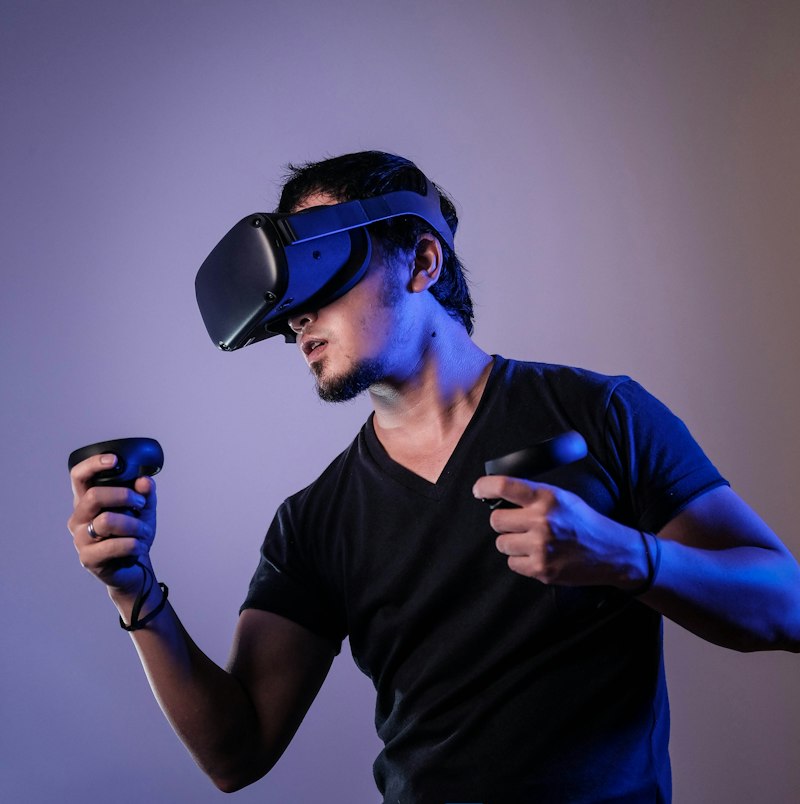
The gap between Tier 1 and Tier 3 isn’t one generation — it’s an entirely different class of photonics and compute.
Related on Techtippr
AI Is Growing Up: Why Agents Are the Upgrade You Didn’t Know You Needed
Hardware Breakdown
Five Devices, Five Architectural Bets
Meta Ray-Ban Display + Neural Band
Tier 2 monocular · $799 · Snapdragon AR2 · 600×600 Micro-OLED
The Ray-Ban Display is Meta’s step into Tier 2 — a monocular 600×600px Micro-OLED display projected at 42 pixels-per-degree with a 20° field of view, hitting 5,000 nits peak brightness. The optics story here is a surface-relief waveguide: a diffractive structure etched into glass that couples light from the display engine into your line of sight. At 20° FoV it’s narrow but usable for HUD-style overlays without the colour fringing artefacts that plagued earlier holographic waveguides.
The included Neural Band is the more technically interesting piece. It’s an EMG (electromyography) wristband that reads muscle activation signals before they reach your fingers, enabling gestural control with sub-10ms latency — effectively a neural interface without implants. The SoC splits inference across the frame (always-on VAD, image capture) and the Neural Band (gesture classification). The cloud handles heavy multimodal reasoning via Meta AI. Total system weight is undisclosed but the frame alone is comparable to standard Ray-Bans.
⚡ 5,000 nits peak
🖐 EMG Neural Band
💰 $799 USD
Architectural bet: Neural interface input + cloud-heavy AI inference offloads most complexity off-device. Works well today; dependent on connectivity for anything non-trivial.
XREAL One Pro
Tier 2/3 hybrid · X1 chip · 57°FoV · Sony 0.55″ Micro-OLED · 3ms latency
XREAL’s X1 is a custom ASIC — not a general-purpose SoC, but a spatial computing chip purpose-built for 3DoF head-tracking and display stabilisation. The result is 3ms motion-to-photon (M2P) latency, which is the threshold below which most humans stop perceiving lag between head movement and display update. That’s a genuinely hard number to hit in a sub-40g form factor and it’s what separates this from competitors using off-the-shelf SoCs.
The display is a Sony 0.55-inch Micro-OLED paired with XREAL’s Optic Engine 4.0 — a geometric waveguide using a birdbath combiner geometry rather than surface-relief diffractive elements. The tradeoff: birdbath combiners are bulkier and have higher reflection loss than diffractive waveguides, but they’re cheaper to manufacture at scale and deliver more consistent colour fidelity. At 57° FoV and 1080p, you’re getting a virtual 171-inch screen at any working distance. For productivity — code editor, browser, document — this is the current best-in-class display experience under $1,000.
⚡ 3ms M2P latency
🧠 Custom X1 ASIC
🖥 700 nits · 120Hz
Architectural bet: Vertical silicon integration (custom ASIC) for display-first workloads. Trades AI inference capability for best-in-class optics performance at price point.
Brilliant Labs Halo
Tier 1/2 · $349 · Alif MCU · On-device Neuphonic AI · Privacy-first architecture
Brilliant Labs is making a distinctly different architectural bet to everyone else: put as much AI inference on-device as possible, avoid the cloud by default, and publish everything as open-source. The Halo uses an Alif Semiconductor MCU — a power-sipping microcontroller that can run quantised small language models locally using INT4/INT8 inference. Their Neuphonic voice AI (Noa) runs entirely on-chip for most tasks, with long-term episodic memory stored locally rather than in a data centre.
The optics are a geometric prism bonded to a MicroOLED — a simple but effective design that weighs under 40g total and delivers all-day battery life because the MCU’s idle power draw is measured in milliwatts. The FoV is approximately 20° diagonal, which is modest, but for the ambient data overlay use-case (time, notifications, Noa responses) it’s sufficient. The privacy architecture is the real differentiator: Gemini, GPT, and other cloud models are optional plugins, not requirements. Alif partnership in early 2026 upgraded the neural processing unit on-die.
🌿 All-day battery
📦 Open-source firmware
💰 $349
Architectural bet: Edge-first inference with privacy guarantees. The right call if regulation tightens on biometric data from wearables — which it likely will.
Google Android XR Glasses (Tier 2)
Monocular · Gemini on-glass · Android XR OS · Multi-OEM strategy
Google’s play is an OS-level wedge, not a hardware product per se. Android XR is a unified platform across glasses, headsets, and spatial devices — and the monocular glasses tier (targeting mid-2026) is their Trojan horse into daily wear. The AI stack is Gemini-native: the glasses can see what you see via an outward-facing camera, run visual question-answering (“what restaurant is this?”), and surface contextual overlays via the monocular display. Critically, Google is building Gemini Nano inference into the on-device pipeline, meaning a subset of queries never leave the hardware.
The three-tier XR strategy signals a willingness to commoditise the hardware layer (multiple OEMs building Android XR glasses) while capturing value in the OS and AI services layer — the same playbook that made Android dominant in phones. The risk: OEM fragmentation in a form factor where millimetre-level fit and weight balance matter enormously. The reward: if it works, Google instantly owns the distribution layer for AR eyewear.
🗺 Maps + YouTube + Uber overlays
🏭 Multi-OEM hardware
📅 Mid-2026 launch
Architectural bet: Platform play — own the OS and AI services layer, commoditise the glass. Highest ceiling if it works; history suggests Google can abandon hardware at any moment.
Apple Smart Glasses (late-2026 / 2027)
Tier 1 target · Apple Silicon wearable · On-device Apple Intelligence · Neural Engine
Apple’s glasses are in late-prototype / high-volume supplier sampling as of Q1 2026 — cameras, microphones, speakers, with Apple Intelligence handling translation, calls, and navigation. No display in the first generation if current leaks are accurate, which is a deliberate Tier 1 entry matching Meta’s proven playbook. The differentiator will be the silicon: Apple’s W-series or a new custom SoC will bring the Neural Engine to the wrist-and-face form factor, enabling on-device inference for the full Apple Intelligence stack without the latency penalties of cloud round-trips.
What matters architecturally is Apple’s vertical integration lock: the glasses will interface natively with iPhone’s Secure Enclave for biometric data, share the CoreML inference graph with AirPods and Apple Watch, and leverage the existing sensor fusion stack from the AW Series 10 for motion estimation. Apple doesn’t need to win the optics war in round one — they need to establish the accessory ecosystem lock-in and then add display capability in Gen 2 or 3. Projected launch: late-2026 at earliest, more likely Q1 2027. Shipments of 3–5M units at launch.
🔗 Deep iOS / Watch integration
📅 Late 2026 / Q1 2027
🏭 3–5M unit launch projection
Architectural bet: Ecosystem flywheel — glasses as the fifth Apple device. Doesn’t need to win on specs; wins by making the other four devices better.
Also on Techtippr
We’re Entering the Agent Era: Claude Mythos Explained Simply
Spec Sheet
Full Technical Comparison
Every number that actually matters for engineering and purchasing decisions — in one place.| Device | Tier | Display / FoV | Chipset | AI Stack | Battery | Price |
|---|---|---|---|---|---|---|
| Meta Ray-Ban Display | Tier 2 | 600×600 Micro-OLED · 20° FoV · 5,000 nits | Snapdragon AR2 + Neural Band EMG | Meta AI (cloud) + on-device VAD | ~6h (frame) | $799 |
| XREAL One Pro | Tier 2/3 | 1080p Sony Micro-OLED · 57° FoV · 700 nits · 120Hz | Custom X1 ASIC (3ms M2P) | Tethered to phone/PC; no on-device AI | Tethered (no battery) | ~$699 |
| Brilliant Labs Halo | Tier 1/2 | MicroOLED prism · ~20° FoV | Alif MCU + NPU (INT4/8 inference) | Neuphonic Noa — fully on-device | All-day | $349 |
| Google Android XR (T2) | Tier 2 | Monocular micro-display (specs TBC) | Multi-OEM · Gemini Nano on-device | Gemini (cloud + on-device split) | TBC | TBC mid-2026 |
| Apple Smart Glasses | Tier 1 (Gen 1) | No display (Gen 1) | Custom Apple SoC + Neural Engine | Apple Intelligence (on-device) | TBC | TBC late-2026 |
Unsolved Problems
The Hard Problems Nobody Is Advertising
Run an always-on SoC at 200–400mW in a 40g frame sitting against your temple, and you have a heat dissipation problem with no heatsink and no airflow. Current Tier 2 devices run noticeably warm. Apple and Qualcomm are both attacking this with smaller process nodes (3nm and below) and aggressive power gating — but thermal is the constraint that limits how much AI you can do on-device before you’re cooking the wearer’s ear.
A waveguide combiner couples a display into your visual field while remaining transparent. The three dominant geometries — surface-relief diffractive (Meta, Magic Leap), geometric (XREAL birdbath), and holographic (Microsoft HoloLens) — each involve brutal tradeoffs between FoV, efficiency, colour uniformity, and manufacturability. Surface-relief gratings give you thin, high-efficiency guides but require nanometre-precision lithography and exhibit “rainbow artefacts” in bright light. Getting to >60° FoV with >50% optical efficiency at <1mm thickness and <$100 BOM cost is an unsolved problem. This is why Tier 3 binocular AR is still years away from consumer price points.
💡 Always-On AI Power Budgets
- Wake-word detection runs at ~1–5mW using dedicated DSP cores — this is solved and cheap.
- Always-on camera + vision pre-processing runs at ~50–150mW — manageable on current nodes with aggressive duty cycling.
- Continuous multimodal inference (vision + language, full context) runs at 300–800mW — this is where glasses either need a battery the size of a deck of cards or a tether to your phone. No device ships continuous full-context AI today. They all buffer, batch, and offload.
- The 2027 problem: Gemini Nano 2 / Apple Intelligence 2 class models running continuously at <100mW is the engineering target that unlocks the “glasses as primary computer” thesis. We are not there yet.
Custom ASICs like XREAL’s X1 and Apple’s upcoming wearable SoC are the inflection point — general-purpose chips simply can’t hit the power and latency targets glasses demand.
The Bigger Picture
Which Architectural Bet Wins?
The honest answer is that the winner in 2028 is probably not the company with the best optics or the best AI model — it’s the company that solves the integration problem first. Glasses are uniquely hostile to the modular, iterative hardware design that worked for phones. You can’t add a bigger battery. You can’t add a fan. You can’t add a bigger waveguide without redesigning the whole frame. Every gram and every milliwatt is load-bearing.This is why Apple’s vertical integration strategy is particularly dangerous to everyone else. They own the SoC, the OS, the sensor fusion stack from Apple Watch, the audio stack from AirPods, and the retail channel. They don’t need to win on specs in Gen 1 — they need to establish that glasses make your existing Apple devices meaningfully better. If they do that, Gen 2 with a display has a captive audience already paying $200/year in Apple One subscriptions.
Meta’s bet is volume and data. Selling 10 million Ray-Bans means 10 million multimodal training samples of what humans look at, point at, and ask about. That’s a dataset nobody else can replicate, and it will compound into AI model improvements that hardware specs can’t compete with. The Neural Band is a fascinating side bet — if EMG gestural control works reliably, it removes the most awkward UX problem in wearables (how do you input without looking insane in public).
The dark horse is Brilliant Labs. Regulation of biometric wearable data is coming — the EU’s AI Act and India’s DPDP Act both have provisions that could seriously complicate cloud-based always-on vision processing. If that happens, on-device-first architectures go from niche to necessary overnight.
Also on Techtippr
Best Free AI Image Generators in 2026 (No Credit Card, No Tricks)
Why You Can’t Focus Anymore (And 6 Science-Backed Fixes)
ADHD and Dopamine: Why Your Brain Chases Distraction (Not Laziness)
What Is Second Screen Syndrome? How Dual-Screening Is Quietly Degrading Your Memory
Stay Ahead of the Hardware Curve
We go deep on the AI and hardware shifts that actually matter — silicon, architecture, tradeoffs. No consumer fluff. Subscribe and we’ll drop the next one straight to your inbox.