
- 01What AI Is Actually Good At for Health
- 02Where AI Gets Health Dangerously Wrong
- 03Should You Trust ChatGPT for a Diagnosis?
- 04How to Use AI for Health Safely
- 05Frequently Asked Questions
- 06How Accurate Is AI for Health, Really?
- 07What About Symptom-Checker Apps and 'AI Doctors'?
- 08Key Takeaways
- 09The Bottom Line
Short Answer
You can use ChatGPT and other AI tools to understand health topics, explain medical terms, prepare questions for your doctor, and get general wellness information — and they’re often good at it. But you should not rely on them to diagnose you, judge how urgent your symptoms are, or replace a doctor. Studies in 2026 found AI chatbots gave wrong or unsafe advice in a meaningful share of urgent cases, under-triaging around half of true emergencies. Use AI as a starting point for understanding, never as the final word on your health — and in an emergency, contact a professional or emergency services immediately.
Hundreds of millions of people now ask AI chatbots about their health — ChatGPT alone reportedly fields tens of millions of health questions a day. It’s easy to see why: it’s free, instant, private, and never makes you feel rushed. But how much should you actually trust ChatGPT for health advice? The honest answer is nuanced: AI is genuinely useful for some health tasks and genuinely dangerous for others. Here’s where the line sits, backed by what the research actually shows.
What AI Is Actually Good At for Health
For information and understanding — as opposed to diagnosis — AI chatbots are a genuinely helpful tool. They’re trained on vast amounts of medical writing, so they’re good at explaining concepts in plain language and helping you feel less lost. Used this way, they can make you a more informed, more confident patient.- Explaining medical terms and test names in plain English
- Giving general, well-established information about a condition or medication
- Helping you understand a lab result at a high level (what a marker generally means)
- Preparing better questions to ask your doctor before an appointment
- Summarizing a long article, leaflet, or discharge note into something readable
- General wellness guidance — sleep, hydration, exercise basics
In one 2026 assessment, ChatGPT gave appropriate advice for around 93% of semi-urgent scenarios — strong performance for general guidance. The key is that these are information tasks, where being roughly right and easy to understand is genuinely valuable.
Where AI Gets Health Dangerously Wrong
The picture changes sharply the moment stakes rise. Where AI fails is exactly where it matters most: judging urgency, handling emergencies, and giving specific, personal medical decisions. The research here is sobering.A 2026 study found that an AI health tool under-triaged 52% of emergency scenarios — misclassifying true emergencies like asthma attacks, diabetic ketoacidosis, and respiratory failure as safe to delay. In nearly half of genuine emergencies, the chatbot failed to tell the person to seek urgent care. Oxford University and Lancet researchers separately warned about AI’s tendency toward hallucinations and harmful omissions — in some tests, omitting emergency precautions or even giving unsafe advice. There is already at least one lawsuit alleging an AI chatbot dismissed the symptoms of a life-threatening pulmonary embolism.
Never use AI to judge an emergency
If you have symptoms that could be serious — chest pain, difficulty breathing, signs of a stroke, severe bleeding, a sudden severe headache, thoughts of self-harm — do not ask a chatbot whether it’s urgent. Contact a doctor or your local emergency services immediately. AI has repeatedly failed to flag real emergencies, and a delay based on a chatbot’s reassurance can be dangerous.
Should You Trust ChatGPT for a Diagnosis?
No — and even OpenAI says so. The company states plainly that ChatGPT was never designed to replace a healthcare provider and that you shouldn’t rely on it as your sole source of medical guidance. AI doesn’t examine you, can’t run tests, doesn’t know your full history, and can state a wrong answer with complete confidence. It also can’t take responsibility for being wrong. A real clinician does all of those things.The safest mental model: AI is a knowledgeable friend who has read a lot, not a doctor. It’s great for understanding and preparation, useless for a definitive personal diagnosis, and actively risky for anything time-sensitive.
How to Use AI for Health Safely
If you do use AI for health topics — and used well, it can genuinely help — a few rules keep it on the safe side of the line:Don’t use AI for
- Deciding whether symptoms are an emergency
- Getting a personal diagnosis
- Setting medication doses or stopping a prescription
- Replacing a doctor’s or pharmacist’s advice
- Anything involving children’s or infants’ care without a professional
Do use AI for
- Understanding what a term or condition means
- Prepping questions before an appointment
- Getting general, well-known health information
- Making sense of instructions you were already given
- Learning about healthy habits and prevention
Always verify and disclose
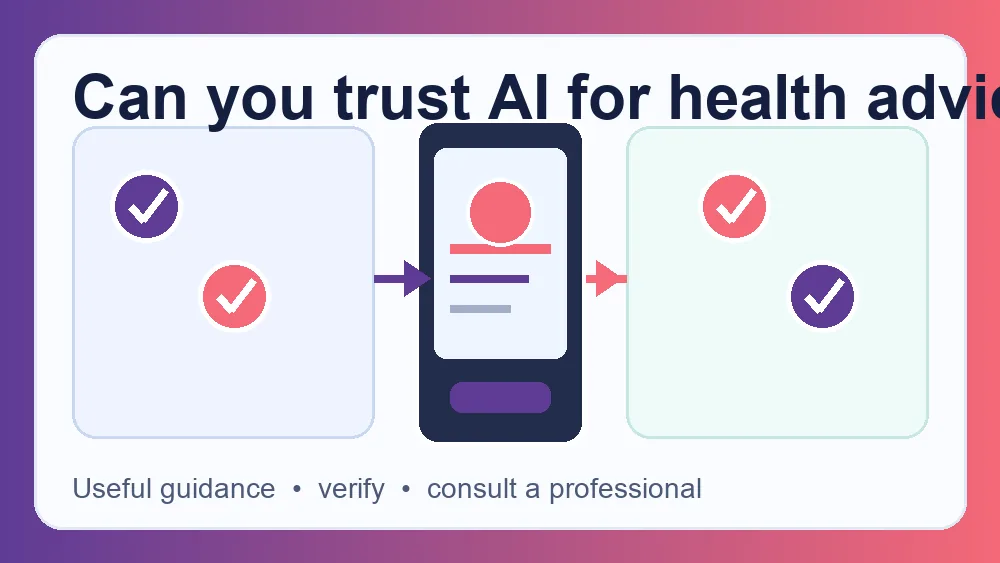
Cross-check anything important against a trusted source (a health service website or a professional), and tell your doctor if AI shaped your thinking — it helps them correct any misunderstanding. For choosing which AI tool to use for research, our comparison of Claude vs ChatGPT vs Gemini can help, and if privacy matters, running an AI model locally keeps your questions on your own device.
Frequently Asked Questions
Is it safe to ask ChatGPT about my symptoms?
For understanding what a symptom might relate to in general terms, it can be informative. For deciding whether your specific symptoms are urgent or what’s actually wrong with you, no — AI has been shown to miss real emergencies and give confident but wrong answers. Treat it as background reading, then talk to a professional.
Why do so many people use AI for health questions?
It’s free, instant, private, and patient — you can ask anything without feeling judged or rushed, and without a waiting room. Those are real benefits for understanding and reassurance. The danger is mistaking that convenience for medical authority; the two are not the same.
Which is more reliable for health info, ChatGPT or Google?
Both point to information rather than provide care. A chatbot is better at explaining things conversationally; a search engine is better for reaching authoritative sources directly (a national health service, a hospital, a medical organization). The most reliable approach is to use either to understand and prepare, then confirm anything that matters with a qualified professional.
How Accurate Is AI for Health, Really?
The accuracy of AI health answers depends enormously on the situation. For general, well-documented questions — what a condition is, what a medication is broadly for, what a term means — chatbots are usually reliable, because that information is stable and widely written about. The 2026 research reflected this, with strong scores on non-urgent, general scenarios. Where accuracy collapses is in messy, real-world cases: vague symptoms, overlapping conditions, and anything where the right answer depends on details only an examination would reveal.This is the crucial nuance most people miss. A tool that is right 90%-plus of the time on easy questions can still be catastrophically wrong on the hard ones — and the hard ones (is this chest pain serious?) are exactly where being wrong does the most harm. High average accuracy hides dangerous failure in the cases that matter most, which is why ‘it’s usually right’ is not a safe standard for health.
What About Symptom-Checker Apps and ‘AI Doctors’?
A wave of apps now market themselves as AI symptom checkers or ‘AI doctors.’ They can be a convenient way to organize your thoughts before a real appointment, and some are built with more medical guardrails than a general chatbot. But they share the same core limitation: they can’t examine you, don’t have your full history, and can’t take responsibility for a wrong call. Treat them exactly like a chatbot — helpful for understanding and preparation, not for diagnosis or deciding urgency.Can AI replace a Google search for health?
For understanding, AI is often friendlier than a search full of conflicting pages. But for reaching authoritative, up-to-date sources — a national health service, a hospital, a specialist body — search still wins, because you can see exactly who is telling you what. The best habit is to use AI to understand and search to verify, then bring anything important to a professional.
Key Takeaways
- AI is great for understanding health topics and prepping for appointments
- It’s unreliable for diagnosis and dangerous for judging emergencies
- In an emergency, contact a professional or emergency services — never a chatbot
- Verify anything important against an authoritative source
- Even OpenAI says ChatGPT isn’t a replacement for a doctor
What health tasks is AI genuinely best at?
Explaining terms and conditions in plain language, summarizing documents you were given, helping you write down clear questions for your doctor, and offering general wellness information. These are understanding-and-preparation tasks — where AI is helpful and low-risk — as opposed to diagnosis or urgency calls, where it isn’t.
The Bottom Line
AI is a powerful tool for understanding health — explaining, summarizing, and helping you ask better questions — and used that way it can make you a more informed patient. But it is not a doctor, it cannot reliably judge urgency, and it has been shown to miss genuine emergencies. Use it as a first step toward understanding, never as the last word, and always bring a real professional into any decision that actually affects your health.This article is for general information only and is not medical advice. Health is a sensitive area — if you’re worried about a symptom or in crisis, please contact a qualified healthcare professional or your local emergency services.