

You’ve been using AI wrong. Not because you’re bad at prompting — but because you’re only asking one advisor.
Here’s a question most people don’t ask: if everyone uses the same AI chatbot and asks roughly the same questions, who gets the edge?
Think about it. You open ChatGPT. You ask for a business idea, a content strategy, a market analysis. Someone else — your competitor, your colleague, the person two tabs away — opens the same tool and asks almost the same thing. The answer they get? Probably 70–80% identical to yours.
So where’s the competitive advantage? Where’s the original thinking? Where’s the judgment that separates a good decision from a great one?
That’s the question that changed how I use AI entirely. And the answer I landed on surprised me.
The real power isn’t in which AI you use. It’s in learning to use multiple AI models together — like a council of advisors, each with a different perspective.
Why One AI Model Is Never Enough
Every AI model is trained differently. They have different data, different fine-tuning, different strengths, and different blind spots.ChatGPT tends to be great at structured, confident responses. Claude is strong on nuance, long-form reasoning, and being honest when it’s uncertain. Gemini pulls from more recent web data and excels at research tasks. Perplexity cites its sources. Mistral is lean and fast. Each one sees the world slightly differently.
When you rely on just one, you get one perspective — shaped by one set of training choices, one set of biases, one set of limitations. It might be a very good perspective. But it’s still just one.
Think about how the best decisions are made in the real world. Not by one person in a room. By a team. A board. A council — where different people with different expertise challenge each other, disagree, refine, and arrive at something none of them would have reached alone.
That’s exactly the model that works for AI.
The “Council of Models” Workflow
Here’s the actual workflow I’ve developed — and it’s simpler than it sounds.Step 1: Brainstorm with your first model.
Take your question or problem to one AI. Ask for ideas, a plan, a structure — whatever you need. Don’t overthink it. Just get the first output on the table.
Step 2: Ask it to structure the thinking clearly.
Before you move on, ask the same model to organize its output. “Summarize this into the 5 clearest points.” or “Give me this as a structured plan I can take to another reviewer.” You want something concrete to hand off.
Step 3: Take that output to a second model and ask it to challenge it.
This is the step most people skip — and it’s where the magic happens. Paste the first model’s response into a second AI and ask: “What’s missing here? What’s the weakest assumption? What would you do differently?”
A different model will often catch things the first one missed. It’ll push back on assumptions that were stated too confidently. It’ll offer angles the first model simply didn’t consider.
Step 4: Synthesize and refine.
Take the critique back to your original model (or do it yourself). Ask it to incorporate the feedback and produce a stronger version. Or do the synthesis yourself — because at this point, you’ve gathered enough perspective to make a smart judgment call.
Step 5: You’re the editor, not just the user.
This is the mindset shift. You’re not just asking AI for answers. You’re running a process. You’re the strategist who decides which inputs to trust, which critiques to apply, and what the final output looks like.
That’s a fundamentally different — and more powerful — way to use these tools.
Real Example: How This Plays Out
Let’s say you’re writing a content strategy for a new product launch.You take the brief to ChatGPT and get a solid, well-structured 5-point content plan. It’s good. But it plays it safe.
You take that plan to Claude and ask: “What’s the riskiest assumption in this strategy? What’s it missing?” Claude points out that the plan assumes a cold audience and doesn’t account for re-engaging existing customers — a whole segment that’s been overlooked.
You take those two outputs and run them through Perplexity to fact-check the market claims and pull in recent data. Some of the assumptions from the first draft are now outdated.
By the time you’re done, your content strategy is sharper, better-researched, and more original than anything a single model would have produced. And it took maybe 20 extra minutes.
That’s the council at work.
The Tools That Are Already Building Around This Idea
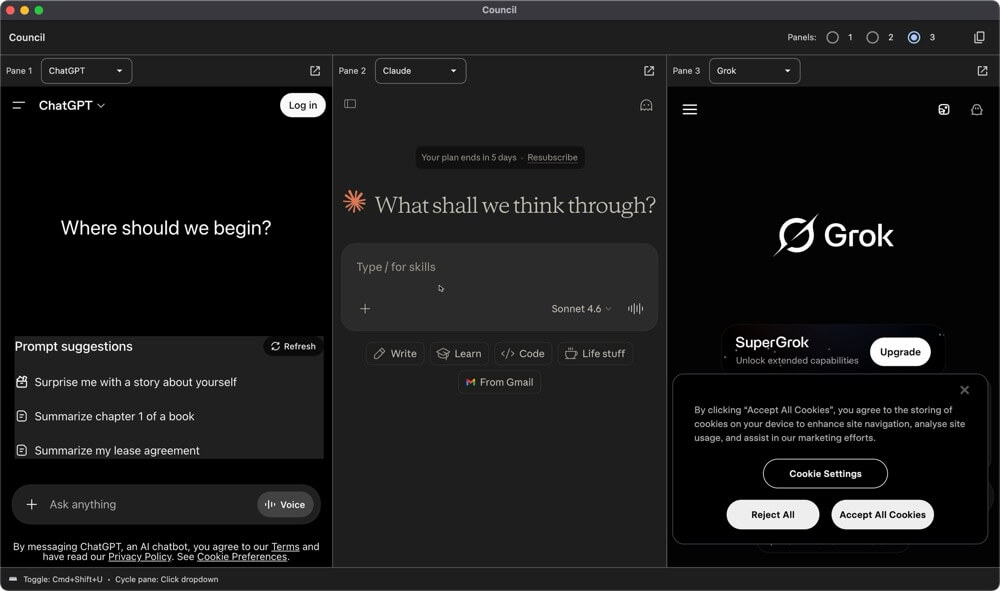
What’s interesting is that some tools are already starting to formalize this concept.There are open-source browser-based AI systems that include a “Council Mode” — where multiple AI agents discuss a problem from different angles before returning a synthesized answer. The idea is that simulating disagreement between models produces better reasoning than any one model reasoning alone.
It’s the same principle that makes adversarial research more rigorous than single-study findings. Or that makes peer review more reliable than self-assessment. Real intelligence often comes from debate, disagreement, and synthesis — not from one confident voice.
We’re still early. But multi-agent AI workflows are rapidly becoming a real category, not just a thought experiment.
Why Most People Won’t Do This (And Why That’s Your Advantage)
Here’s the honest reality: most people won’t run this kind of workflow. It’s a little more effort. It requires switching between tools. It means sitting with ambiguity for longer instead of just accepting the first clean answer.But that friction is exactly where the advantage lives.
The people who treat AI like a vending machine — put in a question, get out an answer, done — will get vending machine results. Convenient. Predictable. The same as everyone else.
The people who treat AI like a thinking partner, a team, a council — who push back, who cross-check, who synthesize — they’ll make better decisions, produce better work, and develop an intuition for when to trust the machine and when to question it.
In a world where everyone has access to the same tools, how you use the tools is the differentiator.
What Changes When You Think This Way
You stop looking for the “best” AI. The question isn’t which model wins. It’s which model is best for this specific step of this specific problem. That’s a much more useful frame.You get more original output. When you’re synthesizing across multiple perspectives instead of accepting one, your final work has more texture, more nuance, and more of your thinking in it.
You become harder to replace. The AI can do a lot. But the judgment layer — knowing which inputs to trust, how to synthesize conflicting advice, when to override the model — that’s distinctly human. And it becomes more valuable, not less, as AI gets more capable.
You develop genuine AI literacy. Not just “I know how to prompt,” but a real understanding of how different models think, where they’re strong, and where they break down. That kind of knowledge compounds over time.
The Bottom Line
One AI gives you answers.A council of AI gives you judgment.
And in the age we’re entering — where information is abundant, answers are cheap, and good decisions are everything — judgment is the asset worth building.
So next time you open your AI tool of choice, try something different. Take the output somewhere else. Ask a harder question. Bring the critique back. See what you end up with.
You might be surprised how much smarter you get when you stop relying on one model — and start running a council.
Which AI tools are you currently using in combination? Drop your stack in the comments — I’d love to see how other people are building their own councils.