
Your Windows PC grinds to a halt. You open Task Manager and see Disk usage at 100% with barely any apps open. This is one of the most common Windows performance complaints — and it almost always has a fixable cause. Here’s how to find and resolve it.
Short Answer: The most common causes of 100% disk usage on Windows: Windows Search indexing (can spike during initial index build), Superfetch/SysMem service, Windows Update running in background, or a failing hard drive. Checking Task Manager → Disk column reveals which process is responsible.
Step 1: Identify the Culprit in Task Manager
- Press Ctrl + Shift + Esc to open Task Manager
- Click More details if you see the simple view
- Click the Disk column header to sort by disk usage
- The process at the top is your culprit
📸 SCREENSHOT NEEDED: Windows Task Manager Processes tab sorted by Disk column, showing one process at near 100% usage
Common Culprits and Fixes
Windows Search (SearchIndexer.exe)
Windows builds a search index when first set up or after updates. This is temporary — let it finish. If it’s been days, disable and re-enable Windows Search:
- Press Win + R → type
services.msc - Find Windows Search
- Right-click → Stop
- Wait a few minutes, then right-click → Start
Windows Update (TiWorker.exe, WUDFHost.exe)
Windows Update downloads and installs updates in the background. Check if updates are pending: Settings → Windows Update. Let them finish — the disk spike is temporary and goes away after restart.
SysMain / Superfetch
SysMain preloads frequently used apps into memory. On older HDDs, it can cause sustained high disk usage:
- Services.msc → find SysMain
- Right-click → Properties → set Startup type to Disabled
- Click Stop then OK
Antivirus Scanning
Real-time scanning or a scheduled full scan from Windows Defender or third-party antivirus causes disk spikes. Check if a scan is running in your antivirus app — let it finish or schedule scans for overnight.
Chrome or Edge “Hardware Acceleration” Bug
Some Chrome/Edge versions cause high disk usage via a graphics rendering bug:
- Chrome: Settings → System → Turn off “Use hardware acceleration when available”
- Restart Chrome
📸 SCREENSHOT NEEDED: Chrome Settings showing System section with Hardware acceleration toggle being disabled
Fix: Upgrade from HDD to SSD
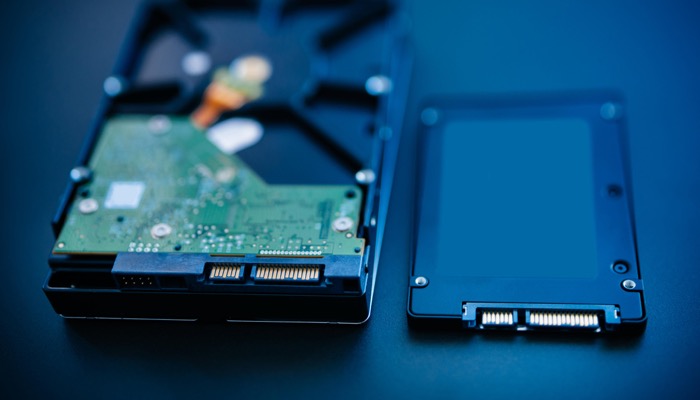
If your laptop or desktop uses a traditional mechanical hard drive (HDD), hitting 100% disk is a structural problem — HDDs can’t handle modern Windows read/write demands efficiently. An SSD upgrade ($35–70 for 500GB) is the most permanent fix and transforms performance.
Check what you have: Task Manager → Performance → Disk — it shows “SSD” or “HDD” in the top-right corner.
Additional Fixes to Try
- Disable Startup programs: Task Manager → Startup → disable high-impact items
- Run disk check: Open CMD as administrator → type
chkdsk C: /f /r→ schedule and restart - Check for failing drive: Download CrystalDiskInfo (free) to check your drive’s SMART health status
Warning: If Task Manager shows ‘System’ or ‘System and compressed memory’ at 100% disk consistently and nothing else fixes it, your hard drive may be failing. Run CrystalDiskInfo immediately to check drive health. A failing drive needs replacing before data loss occurs.
Quick checklist:
- ✅ Sort Task Manager by Disk column to identify the exact process causing the spike
- ✅ Let Windows Update finish — disk spikes during updates are normal and temporary
- ✅ Disable SysMain via services.msc if it’s the culprit
- ✅ Turn off Chrome hardware acceleration if Chrome is spiking disk
- ✅ Run CrystalDiskInfo to check drive health — early warning for drive failure
- ✅ Upgrade to SSD if on HDD — most impactful permanent fix
FAQ
How do I know if my 100% disk usage is from a virus?
Run Windows Defender full scan (Windows Security → Virus & threat protection → Scan options → Full scan). Also check Task Manager for any processes with random or unusual names using high disk — right-click suspicious processes → Open file location to identify them.
Is 100% disk usage always bad?
Short spikes (under 30 seconds) during startup or while Windows does background work are normal. Sustained 100% disk that makes the computer unresponsive for minutes or longer is the problem to fix.
Will a RAM upgrade help 100% disk usage?
Indirectly — if you have less RAM than Windows needs, it uses the disk as virtual memory (pagefile), which can cause persistent high disk usage. Adding RAM (to at least 8GB for Windows 11) can eliminate this cause.
Why Is My Laptop Slow? ↗Best Laptops to Buy
Task Manager’s Disk column tells you everything you need — find the top process, apply the specific fix for it, and the problem resolves. If nothing fixes it, CrystalDiskInfo will tell you if your drive is approaching failure.